

Why Maharashtra’s Onion Crisis Is Again Raising Questions About Farmer Pricing

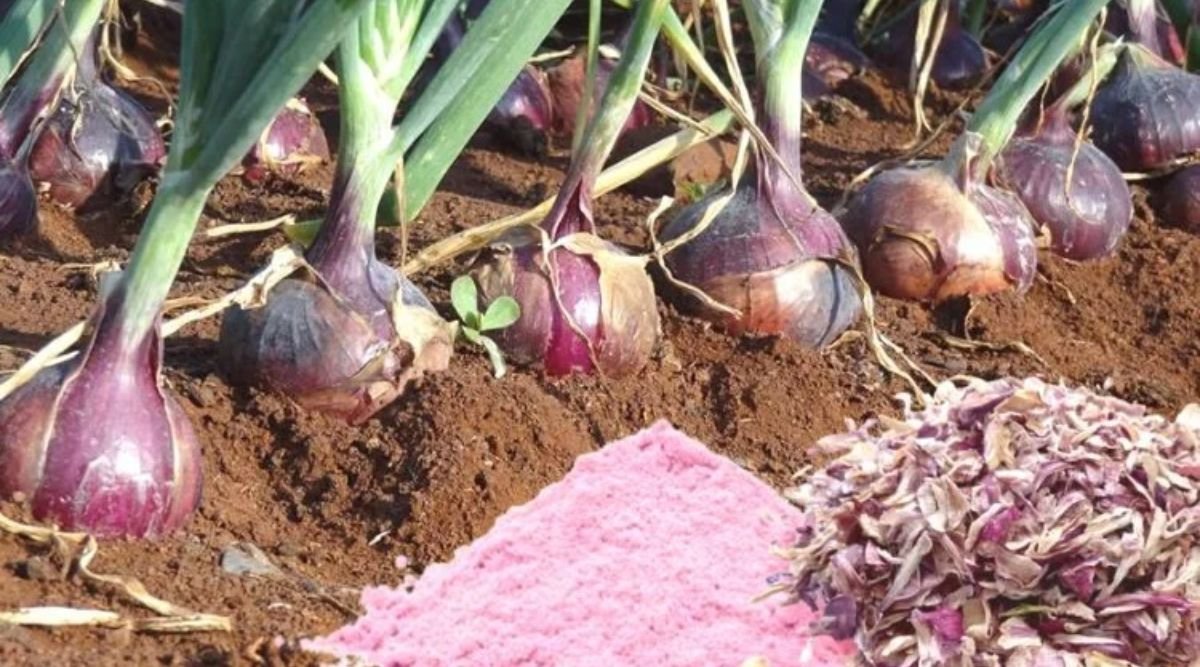
A farmer from Maharashtra’s Chhatrapati Sambhajinagar district recently became the face of India’s growing onion crisis after selling onions at nearly ₹1 per kilogram. The farmer, Prakash Galadhar from Paithan taluka, reportedly sold 1,262 kilograms of onions packed in 25 sacks at the Paithan Agricultural Produce Market Committee yard. After deductions linked with transport, weighing, labour, and mandi charges, he was reportedly left with a loss instead of profit.
The incident spread rapidly across television channels and social media platforms because it highlighted the deep financial stress many onion growers are facing this season. Reports said the farmer earned ₹1,262 from the sale while spending ₹1,263 on associated expenses, effectively losing money after months of cultivation work.
The problem is not limited to one farmer.
Several onion-growing districts across Maharashtra are witnessing severe price crashes because market arrivals increased sharply while demand remained weak. Farmers in Nashik, Solapur, Paithan, and Lasalgaon reported heavy financial losses during recent weeks. In some mandis, onion prices reportedly dropped to ₹400 to ₹800 per quintal for average-quality produce, far below cultivation costs.
Farmer groups say onion cultivation costs currently remain much higher than market returns. According to farmer associations quoted in reports, production costs may reach around ₹1,800 per quintal while many farmers are selling below ₹1,000 per quintal.
In another recent case, a farmer from Solapur reportedly transported onions nearly 200 kilometres to Kolhapur market only to earn around 67 paise per kilogram. Reports said the farmer later burned the remaining crop after facing severe losses.
Why Onion Prices Collapse So Quickly
Onions remain one of India’s most politically sensitive crops because prices fluctuate sharply within short periods.
Agriculture experts say onion prices crash mainly because of three reasons:
- Oversupply during peak harvest
- Weak export demand
- Limited storage capacity
This year, large market arrivals increased pressure on wholesale prices across Maharashtra. Traders quoted in reports said excess supply reduced bargaining power for farmers, especially those bringing lower-grade onions to mandis.
Export disruptions also affected prices. Farmer groups claimed geopolitical tensions and weak international demand reduced onion exports during recent months, increasing domestic supply pressure further.
One major issue behind repeated onion crises is storage infrastructure.
Many small farmers cannot store onions for long periods because scientific storage systems remain expensive or unavailable near villages. Without proper storage, farmers are forced to sell immediately after harvest when mandi arrivals remain highest and prices weakest.
Agriculture experts say better cold storage and onion warehousing systems could reduce distress selling significantly. India launched schemes such as Operation Greens earlier to improve storage, transport, and price stabilization for tomato, onion, and potato crops.
Still, rural storage access remains uneven across many farming regions.
The Crisis Has Revived Debate Around Farm Laws
The incident also revived political debate around the now-repealed 2020 farm laws.
Some commentators argued that farmers continue depending heavily on mandi systems with limited pricing flexibility. Supporters of the farm laws claim broader private market access and direct selling systems might have improved farmer bargaining power beyond local mandis.
The central government had argued in 2020 that the reforms would allow farmers to sell produce outside traditional Agricultural Produce Market Committees and connect directly with buyers across states. Prime Minister Narendra Modi had said the laws would create more competition and improve farmer market access.
Opposition parties and farmer unions, though, strongly opposed the laws at that time. Protesters feared the mandi system and Minimum Support Price framework could weaken gradually if large private players entered agricultural trade heavily.
The laws were eventually repealed after year-long protests.
Farmer groups are now demanding direct government support to offset current losses.
The Maharashtra Onion Farmers’ Association reportedly asked for ₹1,500 per quintal compensation for farmers who sold onions at low prices during recent months.
Some political leaders also demanded guaranteed support prices and stronger procurement systems for onion growers. BJP MLA Ranajagjitsinha Patil recently urged the Maharashtra government to introduce relief measures while also encouraging crop diversification to reduce overdependence on onions.
Maharashtra Depends Heavily on Onion Farming
Maharashtra remains India’s largest onion-producing state and contributes nearly 35 to 40 percent of national onion production according to several reports. Lasalgaon in Nashik district is considered one of Asia’s largest onion markets, and its prices often influence onion trade across India.
Because of this, price crashes in Maharashtra quickly affect farmer sentiment and national political discussion.
Onions also carry strong emotional and political weight in India because retail price spikes affect consumers while wholesale crashes damage farmer income. Governments often struggle balancing both sides at the same time.
Repeated onion crashes are forcing some farmers to rethink cropping decisions.
Reports suggest several growers are considering diversification into fodder crops, pulses, vegetables, and bio-energy crops to reduce risk from onion market volatility.
Agriculture experts say crop diversification may help farmers build more stable income systems instead of depending heavily on one cash crop vulnerable to market swings.
Still, onion cultivation remains deeply linked with rural economies in Maharashtra.
That means unless pricing systems, storage infrastructure, exports, and market access improve together, similar crises may continue returning season after season.
Also Read: Punarnava Jal – The world’s first organic fertilizer! Know how it is beneficial for farmers?
Contact us – If farmers want to share any valuable information or experiences related to farming, they can connect with us via phone or whatsapp at 9599273766 or you can write to us at “kisanofindia.mail@gmail.com”. Through Kisan of India, we will convey your message to the people, because we believe that if the farmers are advanced then the country is happy.
You can connect with Kisan of India on Facebook, Twitter, and Whatsapp and Subscribe to our YouTube channel.