


Ladakh’s Ice Stupa Farming Experiments Are Changing High-Altitude Agriculture

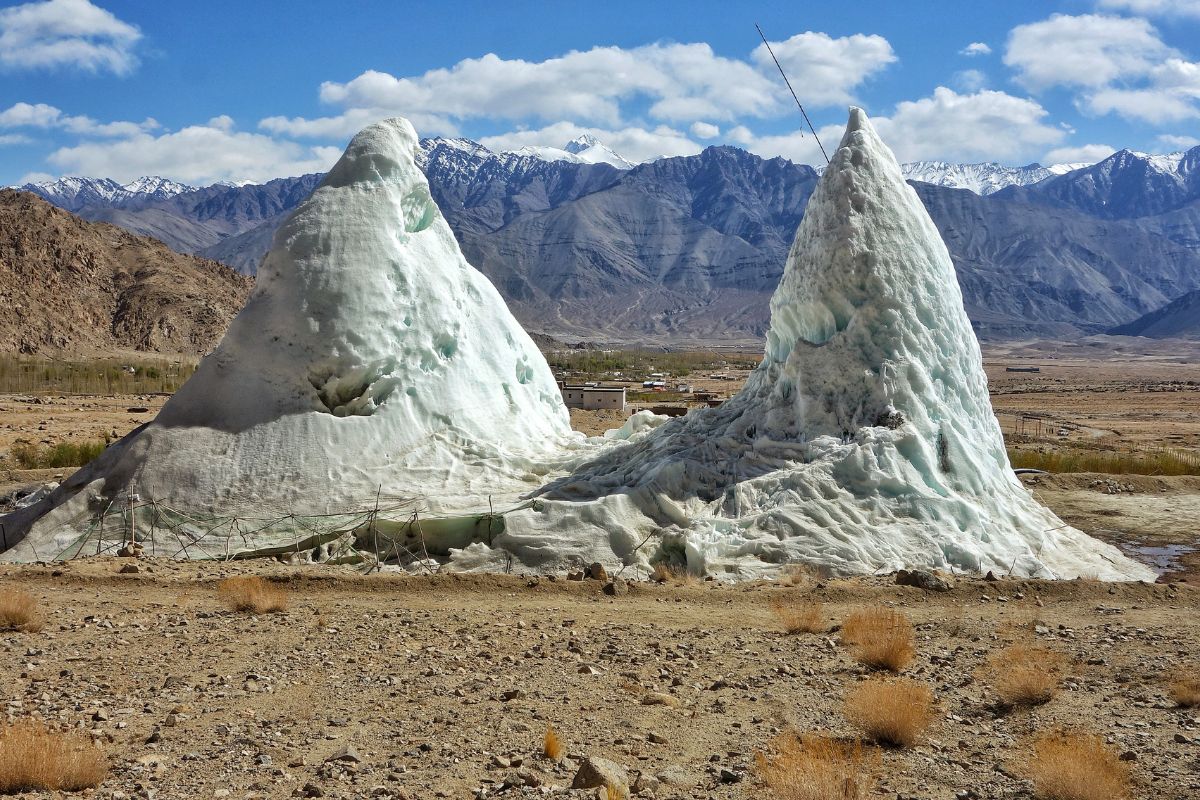
In Ladakh’s cold desert villages, farming has always depended on glacier meltwater flowing down from mountains during spring and summer. Farmers grow barley, peas, mustard, potatoes, and vegetables in one of the harshest agricultural regions in India where rainfall remains extremely low and winters freeze the landscape for months.
But climate change is disturbing that balance.
Glaciers are retreating, snowfall patterns are changing, and water availability during sowing periods has become increasingly unpredictable. Agriculture experts say many villages now face serious water shortages during early spring when crops need irrigation the most.
This crisis pushed Ladakh’s communities toward one of the world’s most unusual climate adaptation systems — artificial glaciers known as ice stupas.
Ice stupas are cone-shaped artificial ice structures built during winter by diverting glacier stream water through pipes. Because winter temperatures remain far below freezing, the sprayed water freezes layer by layer into massive ice towers that can store millions of litres of water.
When temperatures rise during spring, the ice melts slowly and releases water exactly during the agricultural season when villages need irrigation most.
Researchers say the system works as a seasonal water bank for mountain farming communities.
The idea gained global attention after engineer Sonam Wangchuk and local innovators expanded the concept across parts of Ladakh to support climate adaptation and water conservation.
Farmers Use the Water for Early Cultivation
The biggest benefit of ice stupas is timing.
Natural glaciers often melt later in the season, while farmers require water earlier for sowing crops. Artificial ice structures release meltwater gradually during spring, helping farmers irrigate fields before natural stream flow increases.
Agriculture experts say this improves cultivation timing for crops such as:
- Barley
- Green peas
- Leafy vegetables
- Apricot orchards
- Potatoes
Some villages now combine ice stupa systems with drip irrigation and greenhouse farming to maximize water efficiency under cold desert conditions.
Researchers studying Himalayan ecosystems say mountain agriculture is becoming increasingly vulnerable to climate instability. Glacial retreat, reduced snowfall, and changing precipitation patterns are affecting water systems across Ladakh, Himachal Pradesh, Uttarakhand, and other Himalayan regions.
In Ladakh, farming survives almost entirely through controlled irrigation because annual rainfall remains extremely low. Agriculture experts warn that even small shifts in glacier behaviour can affect village-level food systems severely.
Some villages now report shorter water availability periods and greater uncertainty during planting seasons.
Greenhouses Are Expanding in the Cold Desert
Alongside ice stupas, farmers in Ladakh increasingly use passive solar greenhouses to grow vegetables during extreme winters. These structures trap heat naturally and allow year-round cultivation despite temperatures falling far below freezing outside.
Researchers say greenhouse farming is improving local food availability because Ladakh traditionally depended heavily on imported vegetables during winter months.
Now some farmers grow:
- Spinach
- Lettuce
- Cabbage
- Carrot
- Herbs
even during cold periods using protected cultivation systems.
Agriculture experts believe high-altitude greenhouse farming may become more important as climate conditions continue shifting.
Despite growing technological attention, Ladakh’s farming system still depends heavily on traditional community water management practices. Villages often distribute irrigation water through centuries-old rotational systems managed collectively.
Researchers say Himalayan farming communities developed highly adapted agricultural systems suited for fragile mountain environments long before modern climate discussions began.
The ice stupa movement itself combines local ecological understanding with modern engineering rather than replacing traditional knowledge entirely.
Ladakh’s unusual farming systems are increasingly attracting international researchers, climate scientists, and tourists. Visitors now travel to villages to observe artificial glaciers, greenhouse farming, and high-altitude cultivation practices.
Some communities are combining eco-tourism with sustainable agriculture projects to generate additional rural income.
Agriculture experts say climate adaptation projects may create new opportunities for mountain regions if tourism and farming remain balanced carefully.
High-Altitude Farming May Offer Lessons for the Future
The farming systems developing in Ladakh are small in scale compared to India’s larger agricultural regions. But researchers believe they represent something important.
As climate instability increases globally, farming communities everywhere are being forced to rethink water storage, local resilience, and seasonal adaptation.
In Ladakh, farmers are responding not through massive infrastructure projects, but through frozen towers of ice slowly melting into fields beneath the Himalayas.
Also Read: Punarnava Jal – The world’s first organic fertilizer! Know how it is beneficial for farmers?
Contact us – If farmers want to share any valuable information or experiences related to farming, they can connect with us via phone or whatsapp at 9599273766 or you can write to us at “kisanofindia.mail@gmail.com”. Through Kisan of India, we will convey your message to the people, because we believe that if the farmers are advanced then the country is happy.
You can connect with Kisan of India on Facebook, Twitter, and Whatsapp and Subscribe to our YouTube channel.