



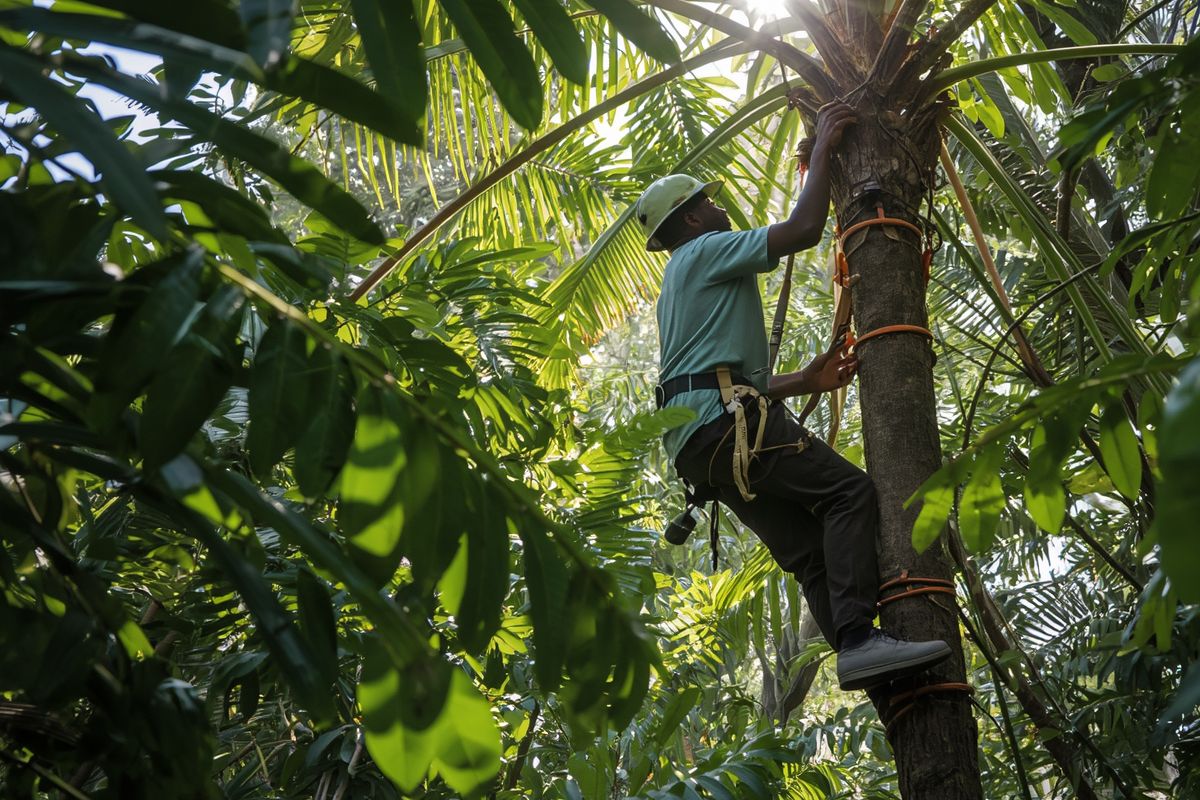
In the arecanut-growing districts of Karnataka, harvesting season has traditionally depended on a specialised skill. Workers climb trees that often exceed 40 to 60 feet in height, carrying harvesting tools while balancing on narrow trunks. The work is physically demanding, risky, and increasingly difficult to sustain as fewer young workers enter the profession.
For plantation owners across Shivamogga, Uttara Kannada, Chikkamagaluru, Dakshina Kannada, and Udupi districts, labour shortages have become one of the biggest operational challenges. Finding experienced climbers is becoming harder every year, while wages continue to rise during peak harvesting periods.
In response, farmers are increasingly adopting mechanical arecanut climbing devices. These tools are helping growers harvest crops more safely while reducing dependence on a shrinking pool of skilled labour.
The technology is emerging as one of the most practical examples of farm mechanisation for plantation agriculture.
Arecanut cultivation supports thousands of farming families across southern India. Unlike many field crops, plantation management requires repeated tree-climbing activities throughout the year for harvesting, spraying, pruning, and maintenance.
Traditionally, these tasks were performed by trained workers capable of climbing tall palms quickly and efficiently. Over time, however, labour availability has declined.
Many younger workers are choosing jobs in urban areas or non-farm sectors, leaving plantation owners struggling to find skilled climbers during critical periods.
The shortage affects productivity directly. Delayed harvesting can influence crop quality and reduce market returns.
Farmers increasingly view labour availability as a long-term structural challenge rather than a temporary problem.
Simple Machines Make Climbing Easier
Mechanical climbing devices are designed to help users ascend and descend tall palms without relying entirely on traditional climbing techniques.
Most systems consist of lightweight frames that attach to the trunk and allow the operator to move upward using controlled body movements. Some models include additional safety features that improve stability during climbing.
The equipment significantly reduces physical strain compared with conventional methods. Farmers who previously avoided climbing due to age or physical limitations can often perform routine tasks independently.
The technology is particularly valuable for smallholders who may not have access to hired labour whenever needed.
For many growers, the devices provide greater control over plantation operations.
Beyond labour shortages, safety concerns are encouraging adoption.
Falls from arecanut trees can result in serious injuries, especially during harvesting seasons when workers climb repeatedly throughout the day. Plantation owners have long recognised the risks associated with traditional climbing methods.
Mechanical devices reduce some of these hazards by providing better support and stability during ascent and descent. While proper training remains essential, users generally report feeling more secure than when relying solely on conventional techniques.
Agricultural extension officers promoting the equipment often highlight safety benefits alongside labour savings.
For many families, reducing accident risks is just as important as improving productivity.
Large plantations can sometimes absorb rising labour costs, but small and medium-scale farmers often face greater difficulties. Hiring skilled climbers for relatively small holdings may not always be economically practical.
Climbing devices offer an alternative.
Farmers can carry out harvesting, spraying, and maintenance activities themselves without waiting for outside workers. This flexibility improves farm management and allows tasks to be completed at the optimal time.
Several farmer groups have also adopted shared equipment models where devices are rented among members, reducing individual investment costs.
Such approaches are helping make mechanisation accessible to a broader range of producers.
Local Manufacturing Expands Availability
One factor supporting adoption is the growth of local manufacturing. Several companies and innovators in southern India now produce climbing devices tailored specifically for arecanut and coconut plantations.
Local production has improved availability while keeping costs relatively affordable. Manufacturers continue refining designs based on farmer feedback, focusing on comfort, durability, and ease of use.
Training programmes organised by agricultural universities, farmer organisations, and extension agencies have further increased awareness.
As more growers witness the technology in operation, interest continues to expand across plantation regions.
The market for specialised plantation equipment is growing steadily.
When people think about agricultural mechanisation, they often imagine tractors, harvesters, or irrigation systems. Plantation agriculture presents different challenges that require specialised solutions.
Arecanut climbing devices demonstrate how relatively simple innovations can solve highly specific problems. The technology does not replace workers entirely, but it helps farmers overcome labour shortages and improve operational efficiency.
Its success reflects a broader shift in Indian agriculture toward practical, problem-focused mechanisation rather than one-size-fits-all solutions.
Farmers increasingly seek tools designed around their actual needs.
A Small Tool Making a Big Difference
The arecanut palm remains one of the most challenging crops to manage because so much work takes place high above the ground.
For decades, growers depended almost entirely on skilled climbers to keep plantations productive. Today, mechanical climbing devices are changing that relationship.
The tools are improving safety, reducing labour dependence, and helping farmers maintain operations more efficiently. In regions where labour shortages continue to grow, such innovations are becoming increasingly important.
For thousands of plantation owners across southern India, the future of harvesting may depend not on finding more climbers, but on climbing smarter.
Also Read: Punarnava Jal – The world’s first organic fertilizer! Know how it is beneficial for farmers?
Contact us – If farmers want to share any valuable information or experiences related to farming, they can connect with us via phone or whatsapp at 9599273766 or you can write to us at “kisanofindia.mail@gmail.com”. Through Kisan of India, we will convey your message to the people, because we believe that if the farmers are advanced then the country is happy.
You can connect with Kisan of India on Facebook, Twitter, and Whatsapp and Subscribe to our YouTube channel.