



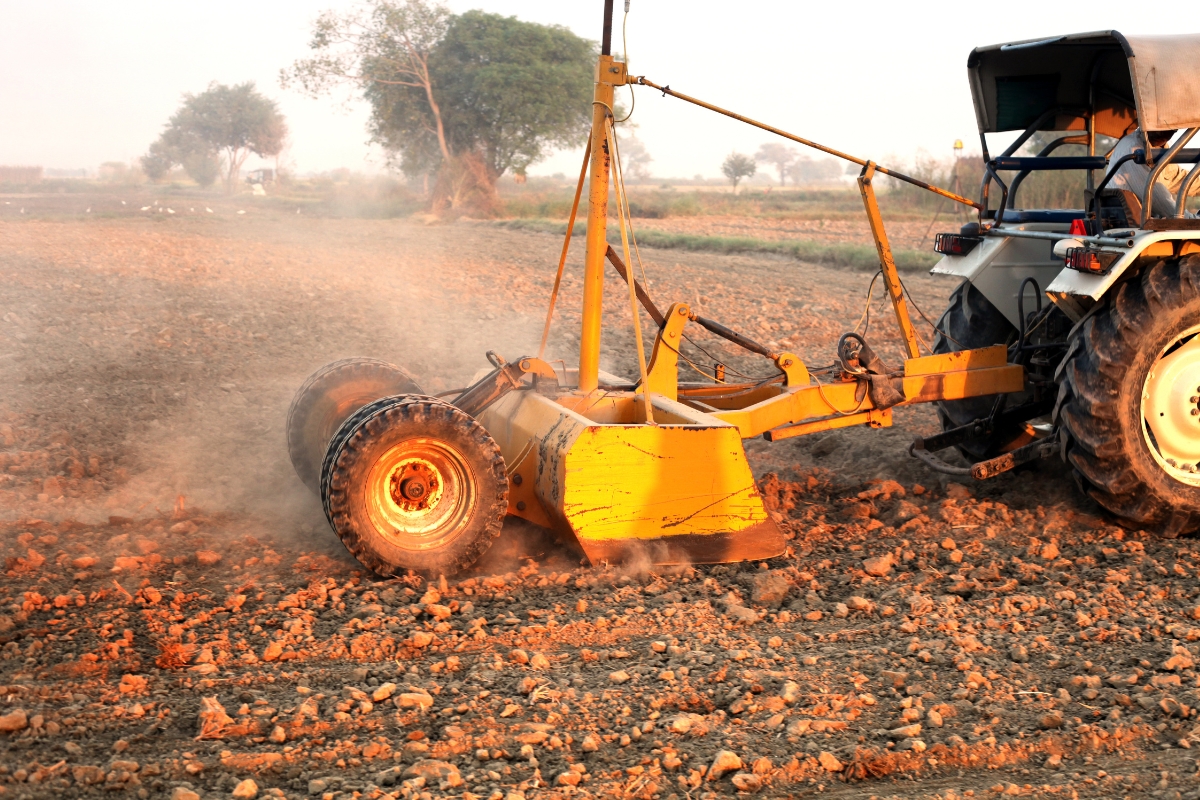
Uneven fields can leave some patches too wet while others remain dry, forcing farmers to use more irrigation. A laser land leveller uses a laser-guided system to smooth the field with greater precision. ICAR lists laser levelling among resource-conserving technologies that can save water, nutrients, labour and energy.
What is laser land levelling?
Laser land levelling is different from ordinary tractor levelling. A laser transmitter sets a reference plane, while a receiver and control system guide the scraper or levelling blade. The operator can remove soil from higher spots and fill lower areas, producing a more consistent field surface.
The machine is especially useful in fields using flood or surface irrigation, where small changes in elevation can affect water movement. It may be less useful where fields already have suitable natural slopes or where irrigation systems do not depend on spreading water across the soil surface.
1. Improve irrigation uniformity
Laser levelling helps create a more even field surface, allowing water to spread across the plot with fewer high and low spots. This can reduce repeated irrigation of dry patches and limit excess water in depressions. ICAR says scientific levelling improves irrigation efficiency and reduces water losses.
2. Support better crop establishment
When moisture is distributed more uniformly, seeds and young plants face fewer major differences in soil wetness. This can help create a more even crop stand. ICAR notes that laser levelling can support uniform crop establishment, while also improving nutrient-use efficiency and reducing input losses.
3. Reduce water losses
Uneven land can make farmers apply extra irrigation because water does not reach every part of the field at the same time. Laser levelling addresses the field-shape problem before irrigation begins. ICAR identifies the technology as a resource-conservation practice that can save water in irrigated farming.
4. Reduce some labour and fuel use
Repeatedly correcting wet and dry patches can require extra field operations, irrigation checks and tractor movement. Better field uniformity can reduce some of these demands. ICAR lists laser levelling among technologies developed to save water, nutrients, labour and energy in Indian farming systems.
5. Improve fertilizer use
A field with uneven moisture can create differences in crop growth and nutrient availability. More uniform land preparation can help water and nutrients reach the crop more consistently. ICAR says laser levelling can improve nutrient-use efficiency, making it useful alongside soil-test-based fertilizer management.
6. Support water-smart farming
Water availability is becoming harder to predict in many farming areas. Better field preparation can help farmers use available irrigation more carefully. ICAR has recently highlighted laser land levelling as part of climate-resilient, water-smart farming, alongside precision seeding, zero tillage and other resource-conserving practices.
7. Check machinery hiring and subsidy options
Farmers do not always need to purchase the machine themselves. Laser levellers can be accessed through machinery services or custom hiring arrangements where available. The Agriculture Ministry’s mechanization portal is currently handling 2026-27 applications under SMAM in states, so farmers should check their state’s current assistance rules.
What farmers should check before using it
Laser land levelling works best when the field is assessed properly and the machine is operated by a trained person. Farmers should compare the service cost with expected water, labour and fuel savings, and seek local advice from a Krishi Vigyan Kendra or agriculture department before arranging the service.
ICAR has also reported field-level benefits from laser-assisted land management. In a pearl millet project in Madhya Pradesh, laser levelling combined with ridge-furrow management was associated with higher yield, additional net returns, lower water use and improved water productivity compared with the farmers’ practice.
Laser land levelling is not simply a machine for making fields look flat. Its main value is better control over how irrigation water moves through the field. For farmers using surface irrigation, proper levelling can support more uniform crops while helping conserve water and reduce avoidable field operations.
Also Read: Punarnava Jal – The world’s first organic fertilizer! Know how it is beneficial for farmers?
Contact us – If farmers want to share any valuable information or experiences related to farming, they can connect with us via phone or whatsapp at 9599273766 or you can write to us at “kisanofindia.mail@gmail.com”. Through Kisan of India, we will convey your message to the people, because we believe that if the farmers are advanced then the country is happy.
You can connect with Kisan of India on Facebook, Twitter, and Whatsapp and Subscribe to our YouTube channel.