



In the arecanut-growing districts of Karnataka, harvesting season has always depended on a specialised skill.
Workers climb trees that often rise more than 40 feet above the ground, carrying tools needed for harvesting, spraying, and plantation maintenance. For generations, experienced climbers formed an essential part of the arecanut economy.
Today, finding those workers is becoming increasingly difficult.
Across districts such as Shivamogga, Chikkamagaluru, Uttara Kannada, Dakshina Kannada, Hassan, and Udupi, farmers report a steady decline in the availability of skilled tree climbers. Younger workers are choosing other occupations, while labour costs continue to rise.
In response, many growers are adopting portable arecanut climbing machines designed to help farmers reach the tops of palms without relying entirely on traditional climbing techniques.
The machines are becoming one of the most visible examples of mechanisation in plantation agriculture.
Arecanut farming requires regular tree access throughout the year.
Farmers need to harvest nuts, remove dried fronds, apply crop protection measures, monitor disease, and maintain plantations. Most of these activities take place high above the ground.
Traditionally, experienced climbers performed the work.
However, plantation owners say labour availability has become one of the sector’s biggest challenges.
Many villages now have only a handful of skilled climbers serving large numbers of farms. During peak harvesting periods, delays can affect operations and increase costs.
The shortage has encouraged farmers to search for alternatives that reduce dependence on specialised labour.
The Machines Allow Farmers to Climb Safely
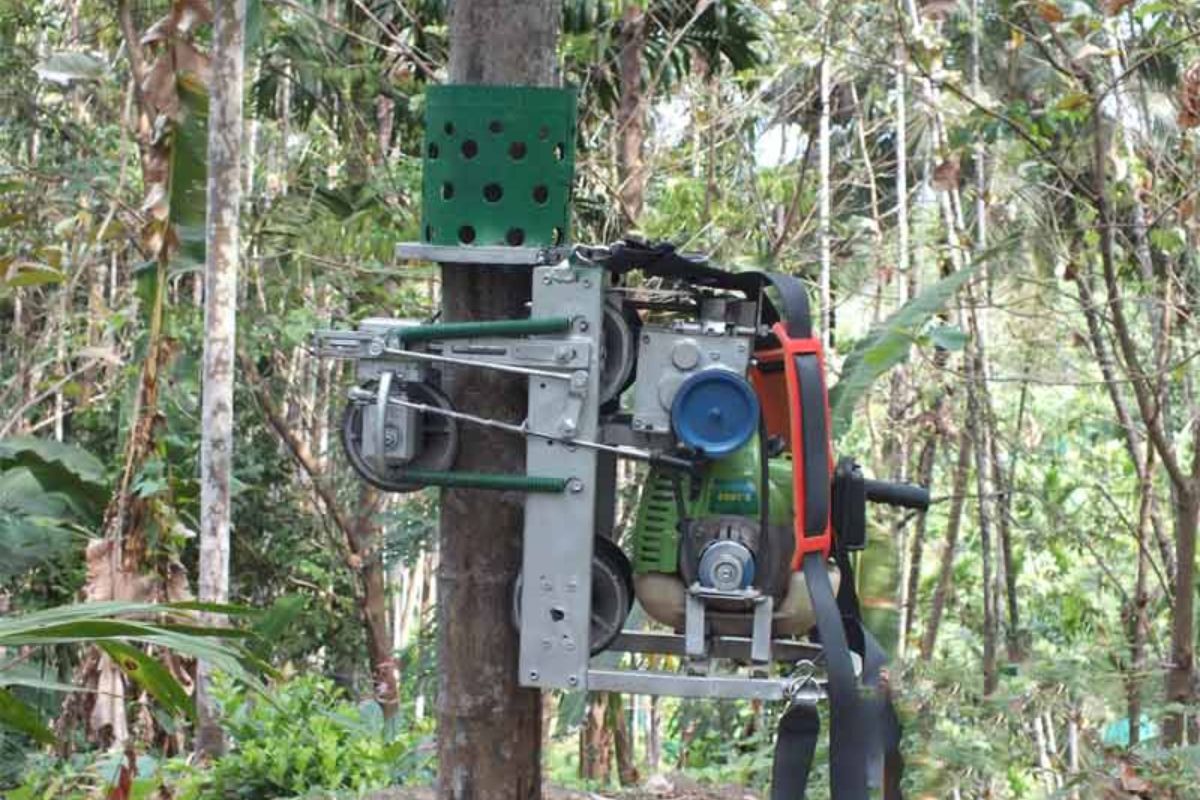
Portable climbing devices typically consist of lightweight metal frames attached to the tree trunk.
Operators secure themselves to the machine and move upward using a simple mechanical system. Most designs are compact enough to be carried between trees and operated by a single person.
The equipment allows farmers to reach heights that would otherwise require traditional climbing skills developed over many years.
For plantation owners, the biggest advantage is independence.
Instead of waiting for labour availability, farmers can perform many routine tasks themselves.
The machines also reduce physical strain compared with conventional climbing methods.
Timing is important in arecanut cultivation. Harvesting delays can affect nut quality and create scheduling problems during peak seasons. Farmers using climbing machines say they can complete plantation work more efficiently because access to trees becomes easier.
The equipment is used not only for harvesting but also for spraying, pruning, disease inspection, and maintenance activities.
This versatility increases its value throughout the year.
Many growers consider the machines an investment that improves overall plantation management rather than simply a harvesting tool.
Tree climbing remains one of the riskiest activities in plantation agriculture. Falls can cause serious injuries and create long-term financial consequences for farming families. Supporters of climbing machines argue that properly designed equipment improves safety by providing greater stability and support while working at height.
Although training remains necessary, many farmers view the technology as a safer alternative to traditional methods.
Agricultural extension agencies have also promoted mechanised climbing solutions through demonstrations and training programmes.
Small Farmers Are Showing Interest
One reason the technology has spread quickly is affordability. Unlike large agricultural machinery that requires major investments, portable climbing machines are relatively inexpensive. Farmer groups, cooperatives, and individual growers can often purchase the equipment without significant financial strain.
Some villages have adopted shared-use models where multiple farmers use the same machine. This approach reduces costs while increasing access to mechanisation. As labour shortages continue, demand for the equipment has expanded beyond large plantation owners to include smallholders as well.
Mechanisation in crops such as wheat and rice has been common for decades. Plantation agriculture has often been slower to adopt machinery because of terrain, crop structure, and operational complexity. The success of arecanut climbing machines demonstrates how specialised tools can address specific challenges in plantation systems.
Engineers and agricultural innovators are now developing similar solutions for coconut, palm, and other tree-based crops. The trend reflects a broader shift toward practical, task-specific mechanisation.
A Small Machine Changing Daily Farm Work
The future of arecanut farming will still depend on farmer knowledge, good management, and favourable market conditions.
Yet access to labour is becoming increasingly important.
Portable climbing machines offer a solution to one of the sector’s most persistent problems.
They help farmers harvest on time, improve plantation management, and reduce dependence on a shrinking pool of skilled climbers.
Across Karnataka’s arecanut belt, the machines are quietly changing how daily farm work gets done.
For many growers, reaching the top of a tree is no longer the challenge it once was.
Also Read: Punarnava Jal – The world’s first organic fertilizer! Know how it is beneficial for farmers?
Contact us – If farmers want to share any valuable information or experiences related to farming, they can connect with us via phone or whatsapp at 9599273766 or you can write to us at “kisanofindia.mail@gmail.com”. Through Kisan of India, we will convey your message to the people, because we believe that if the farmers are advanced then the country is happy.
You can connect with Kisan of India on Facebook, Twitter, and Whatsapp and Subscribe to our YouTube channel.