



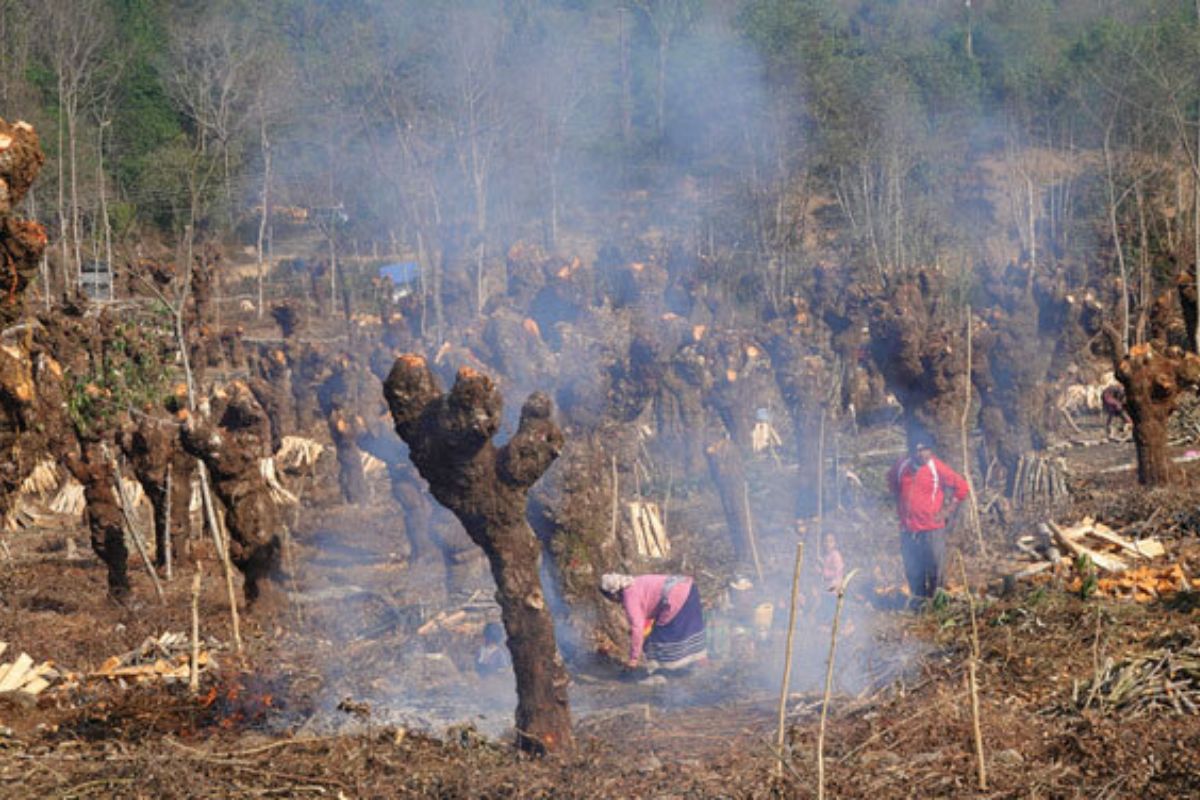
In the steep hills of Nagaland, farmers have practiced a unique form of agroforestry for generations. Unlike many farming systems where trees and crops compete for space, local communities intentionally grow alder trees alongside agricultural crops to improve soil fertility and maintain productivity.
The system, known as alder-based farming, has attracted attention from researchers across the world because it combines food production, forest management, and environmental conservation within a single landscape.
Long before terms such as regenerative agriculture and sustainable farming became common, farmers in Nagaland were already applying many of the same principles through practical experience.
Today, the model is increasingly viewed as an example of how traditional knowledge can contribute to modern agricultural challenges.
In many agricultural systems, farmers remove trees to create more space for crops. Nagaland’s alder farming system takes a different approach.
Farmers deliberately retain alder trees within cultivated areas because the species enriches soil naturally. The tree forms a relationship with nitrogen-fixing microorganisms that help add nutrients to the soil.
As leaves fall and decompose, they contribute organic matter that improves soil structure and fertility.
This process reduces dependence on external inputs while supporting crop production over long periods.
The trees become active partners in farming rather than obstacles to cultivation.
Soil Fertility Improves Naturally
Maintaining soil fertility is one of the biggest challenges in hill agriculture. Heavy rainfall can wash away nutrients, while steep slopes increase the risk of erosion.
Alder trees help address both problems.
Their root systems stabilise soil and reduce erosion during intense monsoon rains. At the same time, leaf litter contributes nutrients that gradually improve soil quality.
Farmers report that fields managed under alder systems often remain productive for longer periods compared with areas where trees are absent.
The combination of nutrient recycling and soil conservation makes the approach particularly valuable in fragile mountain environments.
Healthy soils remain the foundation of the system.
Climate change is increasing pressure on agricultural systems across the Himalayan and northeastern regions. Farmers face irregular rainfall, extreme weather events, and changing growing conditions.
Agroforestry systems such as alder farming are attracting attention because they provide multiple layers of resilience.
Trees help regulate moisture, reduce soil erosion, and improve carbon storage within agricultural landscapes. Their presence can also moderate local environmental conditions during periods of climatic stress.
Researchers studying climate adaptation increasingly point to agroforestry as a practical strategy for improving farm sustainability.
Nagaland’s experience offers a long-established example of how such systems function in practice.
One of the strengths of alder farming is that it supports biodiversity while maintaining agricultural production.
Instead of creating uniform landscapes dominated by a single crop, the system combines trees, crops, and natural vegetation. This diversity supports ecological stability and creates habitats for various organisms.
Agricultural scientists note that diverse farming systems often prove more resilient to pests, diseases, and environmental fluctuations.
Farmers benefit not only from crop harvests but also from ecosystem services provided by healthy landscapes.
The result is a farming model that balances production with conservation.
Traditional Knowledge Guides Management
The success of alder farming depends on generations of accumulated knowledge.
Farmers understand how to manage tree density, prune branches, and coordinate crop cultivation within agroforestry systems. These practices have been refined through long-term observation and experience.
Knowledge is passed from one generation to the next, ensuring that management techniques remain effective under local conditions.
Researchers working in the region often emphasise that the system’s success comes not only from the trees themselves but also from the communities that manage them.
Traditional expertise remains central to its continued effectiveness.
As agricultural systems worldwide search for ways to improve sustainability, interest in traditional agroforestry practices continues to grow.
Nagaland’s alder-based farming system demonstrates that productive agriculture and environmental conservation do not have to be opposing goals. Trees, crops, and people can function as part of a connected landscape that supports both livelihoods and ecological health.
The model cannot be copied exactly everywhere because it evolved under specific environmental and cultural conditions.
Its underlying principles, though, have broad relevance.
In the hills of Nagaland, farmers continue to show how working with nature can support productive agriculture over generations.
That lesson is becoming increasingly important in a changing world.
Also Read: Punarnava Jal – The world’s first organic fertilizer! Know how it is beneficial for farmers?
Contact us – If farmers want to share any valuable information or experiences related to farming, they can connect with us via phone or whatsapp at 9599273766 or you can write to us at “kisanofindia.mail@gmail.com”. Through Kisan of India, we will convey your message to the people, because we believe that if the farmers are advanced then the country is happy.
You can connect with Kisan of India on Facebook, Twitter, and Whatsapp and Subscribe to our YouTube channel.